



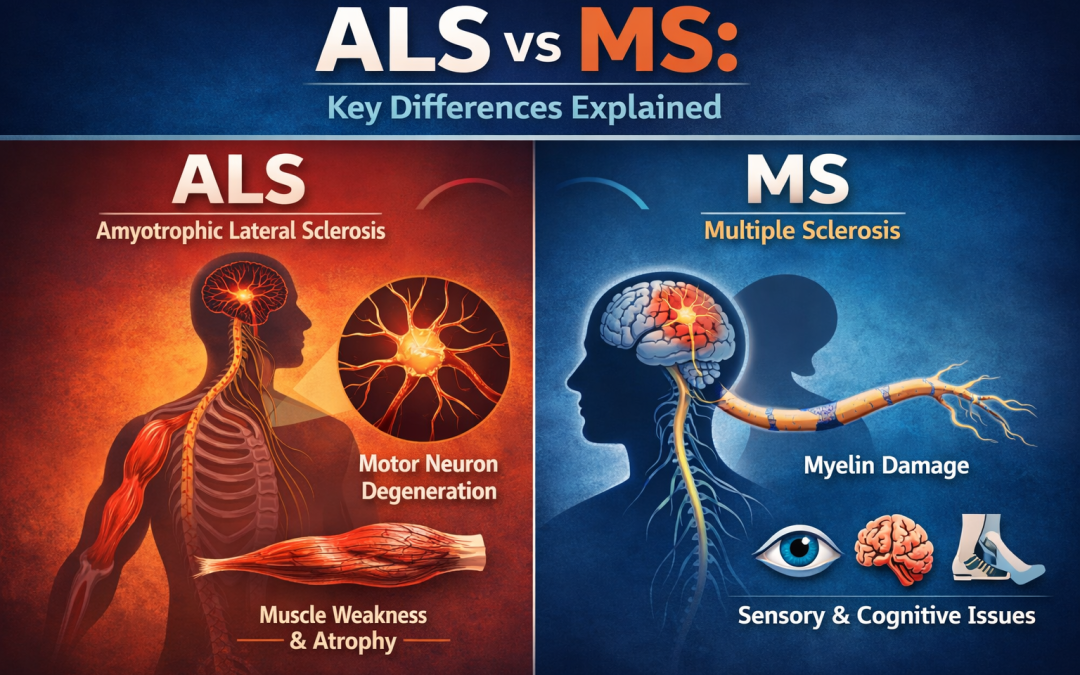
When someone is diagnosed with a neurological condition, one of the most common questions is: Is ALS the same as MS?
The short answer is no. While both conditions affect the nervous system and can cause muscle weakness, Amyotrophic Lateral Sclerosis and Multiple Sclerosis are fundamentally different diseases with different causes, progression patterns, and treatment approaches.
If you or a loved one has already been diagnosed with Multiple Sclerosis and is seeking specialized care in Massachusetts, understanding these differences is essential.
What Is ALS?
Amyotrophic lateral sclerosis, often called Lou Gehrig’s disease, is a progressive neurodegenerative condition that damages motor neurons. These are the nerve cells responsible for voluntary muscle movement.
As motor neurons degenerate, individuals gradually lose the ability to control muscles used for walking, speaking, swallowing, and eventually breathing.
Common Symptoms of ALS
-
Progressive muscle weakness
-
Muscle atrophy
-
Slurred speech
-
Difficulty swallowing
-
Breathing complications in later stages
ALS typically progresses steadily without remission. It is not considered an autoimmune disease.
What Is Multiple Sclerosis?
Multiple sclerosis is a chronic autoimmune condition in which the immune system attacks myelin, the protective covering around nerve fibers in the brain and spinal cord.
When myelin is damaged, nerve signals slow down or become disrupted. This leads to a wide range of neurological symptoms that vary from person to person.
Common Symptoms of MS
-
Vision problems
-
Numbness or tingling
-
Fatigue
-
Balance difficulties
-
Muscle stiffness or weakness
-
Cognitive changes
Unlike ALS, many individuals with MS experience relapsing and remitting phases. With proper monitoring and disease-modifying therapy, long-term outcomes can be significantly improved.
ALS vs MS: Key Differences
Although ALS and MS both affect the nervous system, their mechanisms are very different.
Underlying Cause
The degeneration of motor neurons causes ALS.
MS is caused by an autoimmune attack on myelin.
Type of Damage
ALS destroys nerve cells that control movement.
MS damages the protective covering around nerve fibers.
Progression Pattern
ALS generally progresses continuously.
MS may follow a relapsing-remitting pattern, especially in early stages.
Sensory Symptoms
ALS mainly affects voluntary muscle movement.
MS frequently affects sensation, coordination, vision, and cognition in addition to mobility.
Life Expectancy
ALS significantly shortens life expectancy in most cases.
MS does not typically reduce lifespan dramatically, particularly with early specialist care.
Can ALS Be Mistaken for MS?
Early symptoms such as weakness or difficulty walking can sometimes overlap. However, neurologists use advanced diagnostic tools to differentiate between the two conditions.
MS diagnosis relies heavily on MRI findings that show characteristic lesions in the brain and spinal cord.
ALS diagnosis is based on clinical neurological examination, nerve conduction studies, and exclusion of other disorders. MRI findings in ALS do not show the inflammatory lesions seen in MS.
Accurate diagnosis is critical because treatment approaches are entirely different.
Specialized MS Care in Massachusetts
810 MS Specialty Center provides comprehensive MS therapy services across Massachusetts, including:
-
Boston
-
Waltham
-
Framingham
-
Marlborough
-
Westborough
-
Shrewsbury
-
Hudson
-
Hopkinton
-
Clinton
-
Worcester
You can explore Massachusetts locations here: https://810msspecialtycenter.com/locations/massachusetts/
For patients in Pennsylvania and New Jersey, additional centers are available:
Pennsylvania locations: https://810msspecialtycenter.com/locations/pennsylvania/
New Jersey locations: https://810msspecialtycenter.com/locations/new-jersey/
Because MS is complex and highly individualized, receiving care from a center that focuses exclusively on Multiple Sclerosis can make a meaningful difference.
Why 810 MS Specialty Center
810 MS Specialty Center is dedicated exclusively to individuals diagnosed with Multiple Sclerosis.
Our programs and services include:
-
Physical therapy
-
Occupational therapy
-
Speech therapy
-
Cognitive therapy
-
Balance rehabilitation
-
Gait training
-
Neuromuscular reeducation
-
Maintenance therapy
Learn more about our full range of services.
Our outcomes-driven approach is built on measurable patient progress. View patient outcomes here: https://810msspecialtycenter.com/for-patients/outcomes/
If you are ready to begin specialized MS care, you can schedule an appointment.
Frequently Asked Questions
1. Is ALS an autoimmune disease like MS?
No. MS is autoimmune. ALS is a neurodegenerative motor neuron disease.
2. Is ALS worse than MS?
ALS typically progresses more rapidly and has a more severe impact on life expectancy. MS severity varies widely and often responds well to therapy.
No. MS does not develop into ALS. They are separate neurological conditions.
4. What are the early symptoms of ALS?
Early ALS symptoms may include muscle weakness, twitching, and difficulty speaking or swallowing.
5. What are the early symptoms of MS?
Early MS symptoms often include vision changes, numbness, tingling, fatigue, and balance problems.
6. Does MS always cause paralysis?
No. While MS can cause mobility limitations, many patients maintain independence with proper therapy and management.
7. How is MS diagnosed?
MS is diagnosed using MRI imaging, neurological examination, and clinical criteria.
8. How is ALS diagnosed?
ALS is diagnosed through clinical evaluation, electromyography testing, and exclusion of other neurological disorders.
9. Can people with MS live a normal lifespan?
Many individuals with MS live long lives, especially with early specialist care and consistent therapy.
10. When should someone see an MS specialist?
Anyone diagnosed with MS should consider evaluation at a center focused exclusively on MS rehabilitation and long-term management.
If you or a loved one has been diagnosed with Multiple Sclerosis and are seeking expert MS rehabilitation services in Massachusetts, Pennsylvania, or New Jersey, 810 MS Specialty Center is here to help.
Schedule your appointment today and take the next step toward maintaining mobility, independence, and quality of life.